The Problem
The traditional business card is a static object — a 3.5×2 inch piece of paper that communicates nothing about the person handing it over. For an electrical engineer, this is a missed opportunity. Every networking event, every client meeting, every chance encounter is a moment where you could demonstrate your skills instead of just claiming them.
C.A.R.D was designed to close that gap. The card itself is the portfolio piece.
The Solution
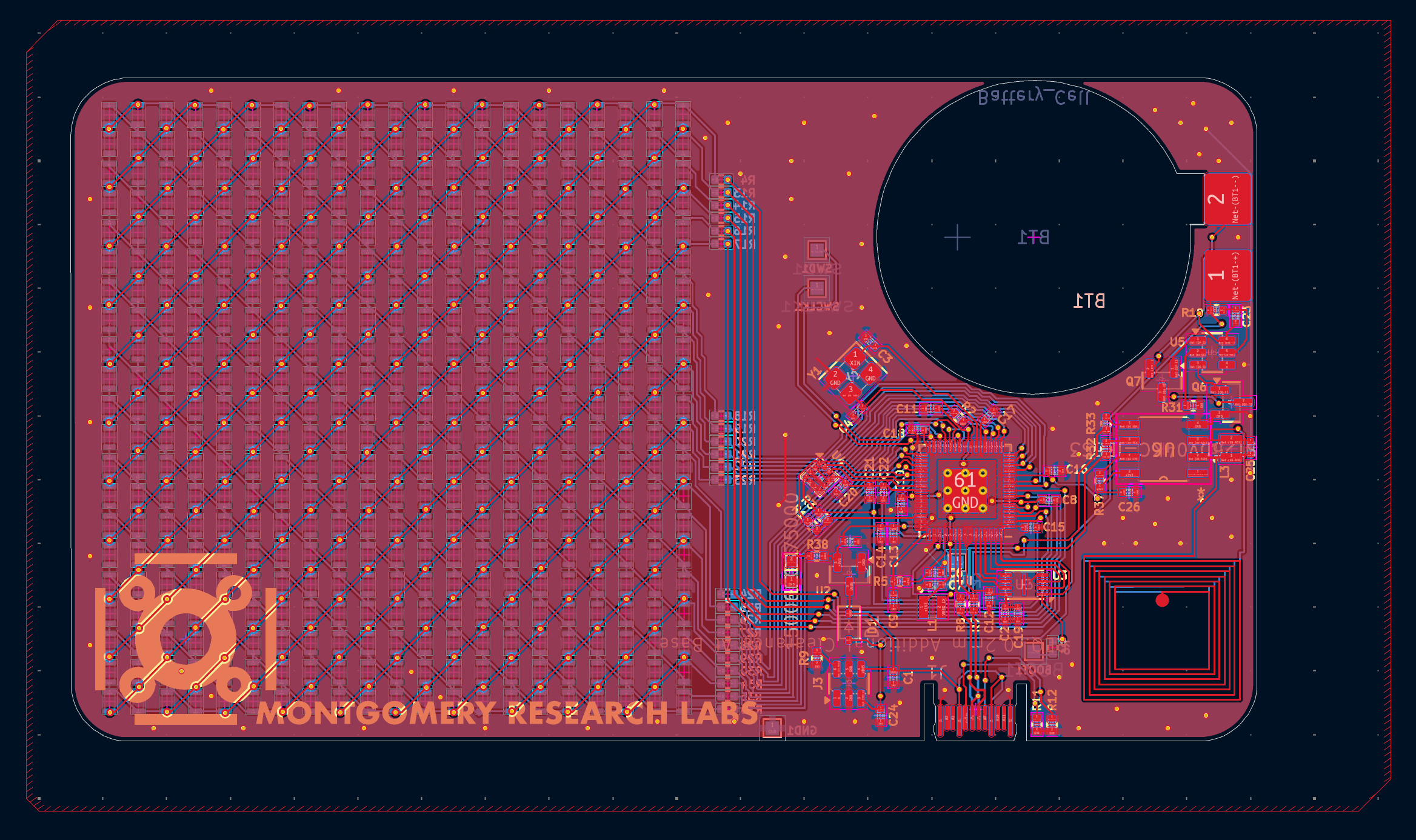
C.A.R.D integrates a complete embedded system into the form factor of a standard business card. The centerpiece is a fluid dynamics animation: 442 green LEDs arranged in a Charlieplexed matrix display a real-time simulation of liquid responding to gravity. Tilt the card forward and the "fluid" flows to the bottom. Rotate it and the fluid sloshes accordingly. The animation is driven by live accelerometer data from the LIS2DH12TR, updated continuously and rendered through the RP2350A.
The interaction is immediate and visceral — no app to open, no QR code to scan. The card is on. The card is performing. And when someone is ready to follow up, a single tap of any NFC-enabled smartphone reads the embedded ST25DV04KC tag and pulls up your contact information.
Engineering Challenges
Routing 442 LEDs on 2 Layers at 1.6mm
The most demanding constraint of this design is the board itself. At 1.6mm total thickness — thinner than a credit card — and with only two copper layers, routing the Charlieplexed LED matrix requires careful planning of every trace. Charlieplexing N GPIO pins enables N²−N LEDs with no additional drivers, but each LED shares lines with others, demanding precise trace topology to avoid unintended illumination and minimize trace crossing.
Real-Time Physics on a Coin Cell
The fluid simulation must run smoothly enough to feel natural while drawing only what a CR2032 can supply. The RP2350A's dual Cortex-M33 cores allow the physics calculation and the LED scanning to be split across cores, maintaining frame rate without sacrificing power efficiency. Optimizing the simulation parameters — viscosity, gravity response, update rate — for perceptual quality at minimum compute cost is an ongoing firmware challenge.
NFC Antenna Near a Copper Plane
NFC antenna performance degrades significantly when placed near conductive copper pours. Designing the ST25DV04KC antenna loop geometry to maintain adequate read range on a board saturated with LED traces requires careful attention to antenna clearance, ground pour cutouts, and coil geometry.
Current Status
Revision E1 is the first hardware prototype and is currently being submitted for PCB fabrication. The schematic and layout are complete in KiCad 9.0. Firmware development is ongoing in parallel, with the accelerometer-driven fluid simulation and NFC payload (business contact data) as the primary development targets. Performance benchmarks and power measurements will be published upon receipt of the first assembled prototype.
Open Source and Inspiration
C.A.R.D is released under the MIT License. All KiCad design files and firmware source are publicly available for the community to study, fork, and build upon.
This project draws direct inspiration from the Flip Card project by Nicholas L. Johnson, whose pioneering work demonstrated the viability of interactive PCB business cards with embedded LED displays. We are grateful for his open-source contribution to the hardware community.
Flip Card by Nicholas L. Johnson:
https://github.com/Nicholas-L-Johnson/flip-card
C.A.R.D (Montgomery Research Labs):